
Powering a maintenance shift
As Australian mining operations electrify, proactive maintenance is changing from a back-of-house function into a vital strategic lever – and Australian Power Equipment is powering that shift.
As mining operations across Australia move to electrification and become more uptime-critical, maintenance is no longer a back-of-house function.
In today’s environment, electrification is now a strategic lever that directly influences safety, production continuity, and long-term cost certainty, as well as providing an opportunity to improve environmental impacts.
For Australian Power Equipment (APE), as a leading low-, medium- and high- voltage power equipment provider, this shift reflects what many mine operators are already experiencing on site: traditional, reactive maintenance models are no longer fit for purpose in modern high-voltage environments.
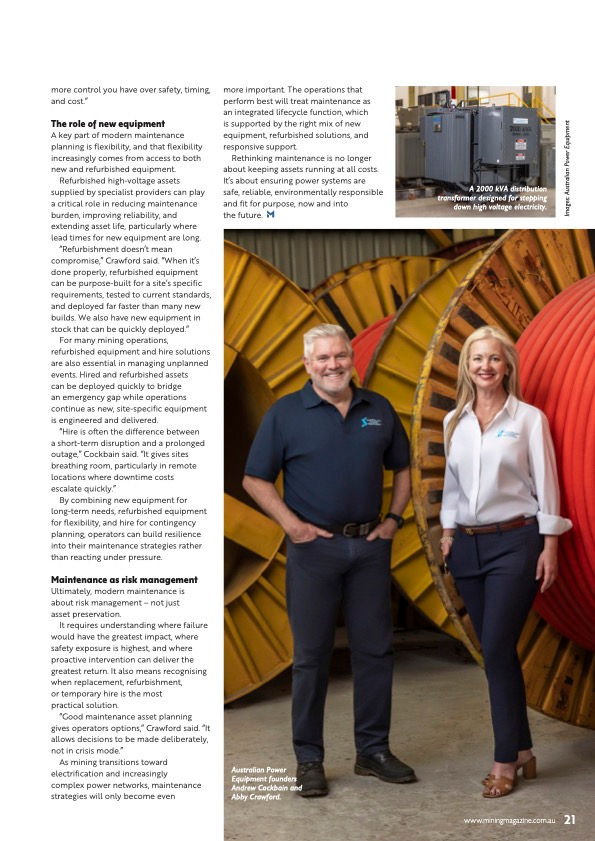
“Maintenance of high voltage equipment has historically been treated as something you respond to when equipment fails,” APE co-director Andrew Cockbain said.
“But in today’s mining operations, failure isn’t just inconvenient, it’s a safety risk, a production risk, and a commercial risk.”
Electrical mining maintenance has traditionally focused on keeping assets running for as long as possible, often pushing aged infrastructure well beyond its original design intent. While this approach may have worked in the past, it exposes operations to increasing levels of unplanned downtime, compliance risk, and extended outages when replacement equipment cannot be sourced quickly.
Now, many operators are moving toward preventive and lifecycle-based maintenance strategies, looking not just at individual assets but at how entire power systems perform over time.
“At APE, we see maintenance as a system, not a service,” APE co-director Abby Crawford said. “It’s about understanding how substations, transformers, cables, accessories, and supporting infrastructure work together, and where the real operational risk sits across the lifecycle.”
This system-level approach enables operators to plan redundancy earlier through asset renewal, improve cost certainty, and align maintenance decisions with future power demand rather than past assumptions. It also enables consideration of how electrical equipment is powered, with APE offering FR3 fuelled equipment improving environmental outcomes.
Despite this shift, some of the highest- risk areas in mining power infrastructure remain consistently underestimated.
Cable systems and accessories, for example, are often viewed as static assets. In reality, they are exposed to mechanical handling, thermal loading, environmental conditions, and changes in duty that can significantly reduce service life if not actively managed. Another common risk is the ‘it’s still working’ mindset. Assets may remain operational while insulation systems degrade, protection technology becomes obsolete, or capacity no longer matches operational demand. Waiting until failure often removes flexibility, forcing urgent decisions, extended downtime, or compromised solutions.
“We regularly see infrastructure that’s been pushed well beyond what it was originally designed for,” Cockbain said. “By the time it fails, options are limited. The earlier you address those risks, the more control you have over safety, timing, and cost.”
The role of new equipment
A key part of modern maintenance planning is flexibility, and that flexibility increasingly comes from access to both new and refurbished equipment.
Refurbished high-voltage assets supplied by specialist providers can play a critical role in reducing maintenance burden, improving reliability, and extending asset life, particularly where lead times for new equipment are long.
“Refurbishment doesn’t mean compromise,” Crawford said. “When it’s done properly, refurbished equipment can be purpose-built for a site’s specific requirements, tested to current standards, and deployed far faster than many new builds. We also have new equipment in stock that can be quickly deployed.”
For many mining operations, refurbished equipment and hire solutions are also essential in managing unplanned events. Hired and refurbished assets can be deployed quickly to bridge an emergency gap while operations continue as new, site-specific equipment is engineered and delivered.
“Hire is often the difference between a short-term disruption and a prolonged outage,” Cockbain said. “It gives sites breathing room, particularly in remote locations where downtime costs escalate quickly.”
By combining new equipment for long-term needs, refurbished equipment for flexibility, and hire for contingency planning, operators can build resilience into their maintenance strategies rather than reacting under pressure.
Maintenance as risk management
Ultimately, modern maintenance is about risk management – not just asset preservation. It requires understanding where failure would have the greatest impact, where safety exposure is highest, and where proactive intervention can deliver the greatest return. It also means recognising when replacement, refurbishment, or temporary hire is the most practical solution.
“Good maintenance asset planning gives operators options,” Crawford said. “It allows decisions to be made deliberately,not in crisis mode.”
As mining transitions toward electrification and increasingly complex power networks, maintenance strategies will only become even more important. The operations that perform best will treat maintenance as an integrated lifecycle function, which is supported by the right mix of new equipment, refurbished solutions, and responsive support.
Rethinking maintenance is no longer about keeping assets running at all costs. It’s about ensuring power systems are safe, reliable, environmentally responsible and fit for purpose, now and into the future.



Comments